AN INTERACTIVE DIGITAL EXHIBIT IN PLASMA PHYSICS
From the Z-Pinch to shear-flow stabilized
Bennett-Shumlak-Hartman Vortices.
A journey through the early history of magnetic fusion energy (MFE), the problem of plasma instability, and the mathematical structure of a Kadomtsev stable, shear-flow stabilized Z-pinch equilibrium.
Begin the exhibition ↘01 / 07 — THE HISTORICAL PROMISE OF FUSION
Crowing Victory
When fusion energy research was first internationally declassified in the 50s, buoyed by the success of controlling nuclear fission, and the simplicity of concepts like the Z-pinch, scientists thought fusion was only a decade away.
However, they were wrong!
Plasma had other ideas — The axisymmetric Z-pinch,
may have been one of the simplest possible magnetic confinement fusion configurations (MCF) that promised an economical approach to the task without needing applied magnetic fields, but it was prey to virulent fundamental magnetohydrodynamic (MHD) modes that limited lifetimes to nanoseconds (ns) — too short for fusion to create net power.
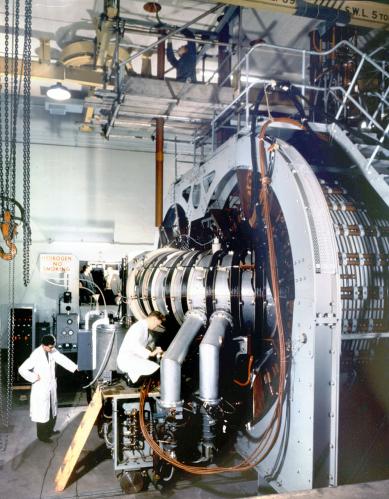
Early Z-pinch experiment performed by UK researchers that briefly raised hopes for fusion before it was clarified that most of the neutrons were produced by non-thermal processes rather than thermonuclear fusion
https://www.energyencyclopedia.com/en/nuclear-fusion/history/pinch#ee-section-zeta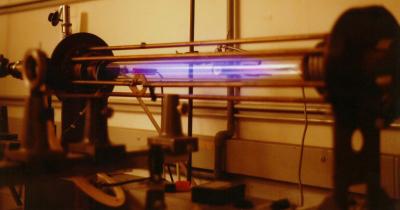
The invention of James Tuck at Los Alamos. One of the earliest Z-pinch experiments that revealed the severe nature of the plasma instabilities to the configuration.
Sandpiper/Wikipedia.org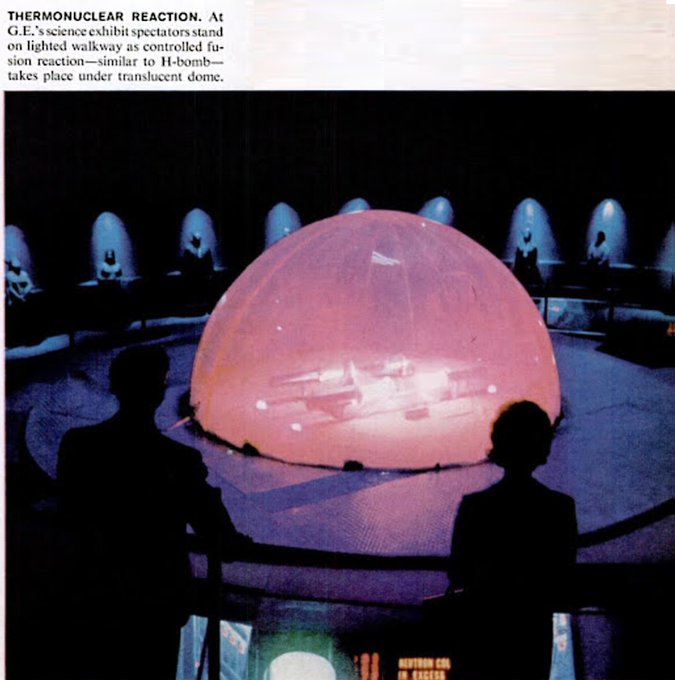
Historical exhibition at the Progressland event introducing the promise of controlled fusion using theta-pinches which are a cousin of the Z-pinch based on an azimuthal current and an axial magnetic field instead of vice-versa.
https://www.reddit.com/r/RetroFuturism/comments/xk1dls/nuclear_fusion_demonstration_at_ges_progressland/#lightbox02 / 07 — THE PHYSICAL PROBLEM
The Z-pinch is unstable.
Being a simple axial MHD equilibrium with a self-generated magnetic field is simple, but does not guarantee stability. Two azimuthal modes exist that lead to positive feedback loops which cause the pinch to collapse when perturbed by them.
The Sausage and Kink modes
Two Positive Feedback Loops — When studying plasma instabilities in the Z-pinch we consider perturbations to the plasma displacement whose azimuthal, , and axial, components are described by a plane-wave,
The sausage mode, , and kink mode, , are the two primary instabilities that plague the Z-pinch. Ways to stabilize the system against this either require means that are incompatible with a fusion reactor, e.g., wall-stabilization, or introduce externally applied magnetic fields and do away with the main advantage of the Z-pinch: it generates its own confinement.
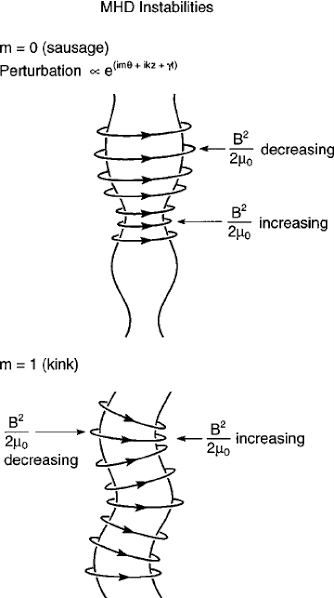
Diagram of the sausage and kink modes showing the mechanism behind the destabilization of a pure Z-pinch plasma. By itself the plasma remains stable, but if the magnetic field at any point becomes perturbed the difference in magnetic pressures leads to the plasma column quickly becoming pinched off.
https://www.researchgate.net/figure/The-m-0-sausage-mode-and-the-m-1-kink-mode-MHD-instabilities-in-a-Z-pinch_fig3_23490383603 / 07 — Shear-flow stabilization and Kadomtsev Stability
Natural ways to stabilize the Z-pinch
Sheared axial flow, and a logarithmically tailored plasma pressure profile, change the dynamics of perturbations and provide a route toward stabilizing Z-pinch configurations against both the sausage and kink modes.
Scientific Miracles
At the frontier — Work on Z-pinch stabilization in the 60s experienced a major breakthrough when the Russian scientist B.B. Kadomtsev determined that a plasma pressure profile which satisfied the inequality,
will provide stabilization to an unsheared Z-pinch against the mode. However, this did not address the kink mode, and in the late 70s, and early 80s, fusion energy researchers began to transition away from pinches, and towards toroidal systems that connected the ends of the pinch together to eliminate end losses and create systems that external magnetic fields could confine.
It wasn’t until the mid-90s when two American researchers found a natural way to stabilize the mode using sheared-flow of a sufficient magnitude. By dividing the axial shear by the Alfvenic shear the linearized equations of MHD could be solved numerically to determine how much shear was required for this stabilization. The result is the Shumlak-Hartman criterion,
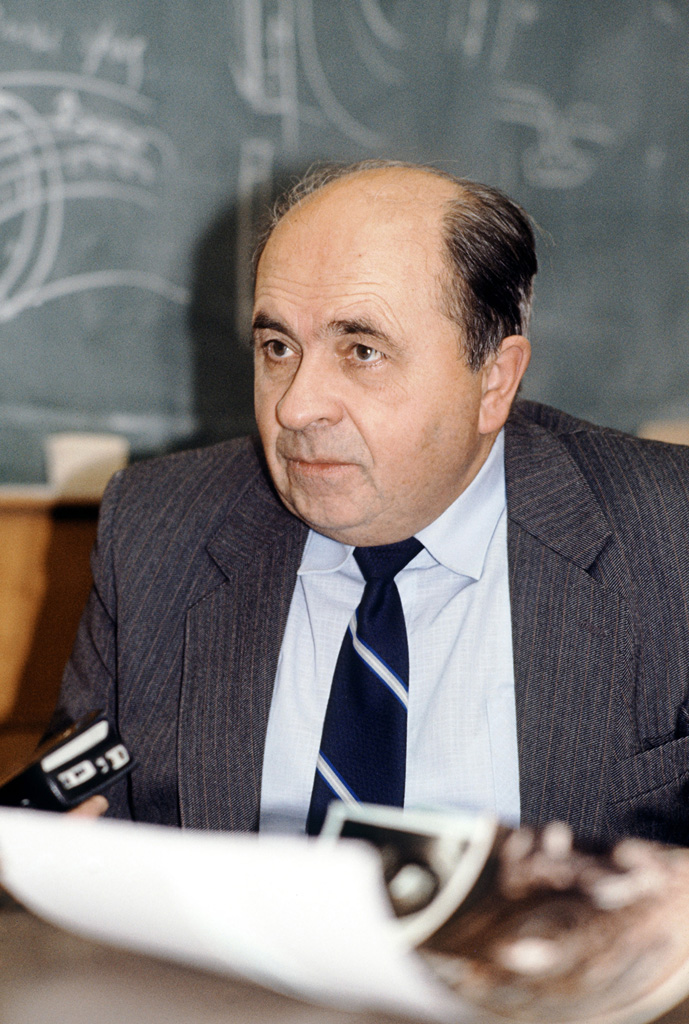
Boris Borisovich Kadomtsev contemplating answers to deep questions in nonlinear plasma physics
https://en.wikipedia.org/wiki/Boris_Kadomtsev#/media/File:RIAN_archive_151311_Russian_physicist_Boris_Kadomtsev.jpg
The Jewish-American physicist Uri Shumlak, one of the pioneers of the shear-flow stabilization criterion, the scientific brains behind Kerbal Space Program, and probably the second best known Aggie behind Johnny Manziel
https://bpb-us-e1.wpmucdn.com/sites.uw.edu/dist/f/10876/files/2021/02/UriOut-square-1.jpg04 / 07 — THE ANALYTIC CONSTRUCTION OF A KADOMTSEV STABLE SHEAR-FLOW STABILIZED Z-PINCH EQUILIBRIUM
A Cosmic Joke
The universe has a sense of humor, because to find physics that provides the Z-pinch stability against the interchange, $m = 0$, mode you have to first exchange one around
Willard H. Bennett and the Bennett Pinch
Another godfather of plasma physics — The American scientist Willard H. Bennett worked out the electrostatic theory of magnetically self-focusing streams in 1934 where he used an approximate, self-similar argument to come up with the basis for a non-relativistic number density to describe these systems,
The cubic pureflow Bennett-Shumlak-Hartman-Vortex
If you swap this with the uniform drift flow that he studied you’ll get a new flow profile,
Treating this also as the MHD flow that provides the stabilizing shear, in the ideal limit of an infinitely long plasma cylinder the Shumlak-Hartman criterion relaxes,
and with a power-law temperature profile,
it can be shown that gives a sufficiently enhanced thermodynamic gradient for this flow to be shear-flow stabilized.
Inserting the minimum thermal energy shear-flow stabilized state, , leads to
which has the shear,
where
localizes the shear layer.
The interactive graph below evaluates these profiles.
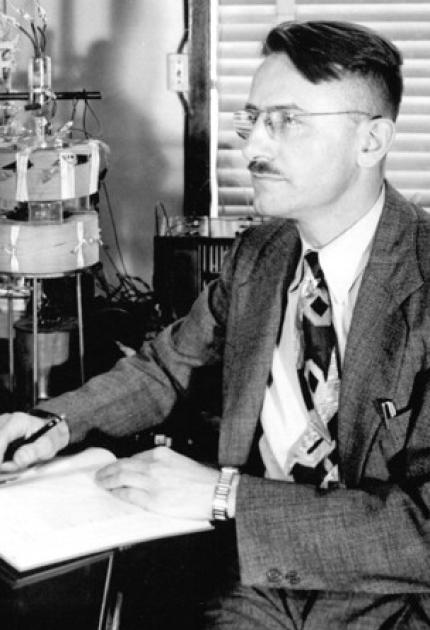
Willard Bennett thinking about one of the many advances in physics, and chemistry that he contributed to.
https://www.invent.org/sites/default/files/styles/inductee_media/public/inductees/12-master_0.jpg?h=754009f3LIVE MATHEMATICAL MODEL
Axial velocity & radial shear
Illustrative normalized profiles. Axes share the same numeric scale; physical units and stability conclusions require the full model assumptions.
05 / 07 — The Kadomtsev Connection and Shear-flow stabilization
Shear-flow Stabilization
By linking the drift flow supporting the plasma current density with the center of mass flow a full integrable MHD equilibrium can be determined that is shear-flow stabilized in both ideal and non-ideal senses, as well as Kadomtsev stable
Solving the equilibrium
Stabilization of the Z-pinch hinges upon not just the aforementioned Kadomtsev criterion, but also the Shumlak-Hartman criterion. There is also a non-ideal criterion whose form is approximately rendered here,
This approximate version of the non-ideal criterion will not be considered here at the moment.
In order to evaluate the Shumlak-Hartman, and Kadomtsev criteria, we first have to determine the rest of the magnetohydrodynamic equilibrium beyond the uniform density implied by the Bennett exchange procedure, and the cubic pureflow Bennett-Shumlak-Hartman vortex. This means determining the magnetic field, and the plasma pressure by solving some integrals.
The magnetic field for a stationary Z-pinch comes from Ampere’s Law,
and the plasma pressure comes from the force balance,
with the boundary conditions
If these integrals do not evaluate, or if the magnetic field that we obtain from Ampere’s Law blows up at the origin, then the clever physics we have done is incoherent. However, fortunately that is not the case because the magnetic field can be integrated using u-substituion or a computer algebra system (CAS) like Wolfram Mathematica. In formulating the following equation we have assumed that the plasma current density for a singly-ionized hydrogen-electron plasma,
depends on the exact same flow profile that we constructed for the center of mass MHD flow,
This leads to Ampere’s Law being,
where,
What’s amazing about this function is that it has exactly the properties that we need for our procedure to be valid. Instead of blowing up at the origin we have,
Evaluating Shumlak-Hartman
To evaluate Shumlak-Hartman, we evaluate the following fraction,
which becomes,
Another critical property about the magnetic field “form function”, , is that its first and second derivatives also go to zero approaching the origin,
This is important because what is most interesting about this mathematics is whether the shear-flow stabilization holds in an arbitrarily small space, i.e., what the fraction we are studying evaluates to for and . We have to use L’Hopitals rule twice in this study, yielding,
Obviously, infinity is greater than
unless there is no plasma density or zero length. However, that just means is required, so the length of the plasma cylinder only has to be finite for this equilibrium to be shear-flow stabilized towards the axis. However, this does not determine what the properties are when the pinch radius shrinks to an infinitesimally small size.
For that we start by considering a scaling relationship between the plasma radius, , and the pinch radius, ,
where is some fixed fraction. Then we have,
with,
so that the criterion is strongly-satisfied towards the axis in an arbitrarily small pinch! Meaning, causes the shear structure to diverge to .
The Kadomtsev Criterion
The Kadomtsev criterion can be written equivalently as,
where is the adiabatic (polytropic) index, and where
is area-averaged current density. The derivative here is a doozy, but we can evaluate it,
with,
so that we have,
which becomes,
For the equilibrium shown here we can prove that this is satisfied for all physically admissible parameter values of the positive-current pureflow vortex. This follows from the structure of the current density which can be seen to be always positive for any combination of plasma parameters and positive flow speed modulus squared. Then, the same can be said for the magnetic field via Ampere’s Law as integrating this always positive current density will result in a magnetic field that has the same property.
Consequently, holds throughout the domain for any , and does as well because . Similarly, holds likewise, as the integrand is the same as for . This leaves us with the need to prove that . Writing,
we have,
The current density here increases monotonically with radius because,
so we have for any allowing us to write,
but can be pulled outside the RHS to give,
which leaves us with,
and this is precisely,
therefore,
so that we have the Kadomtsev-equivalent criterion satisfied.
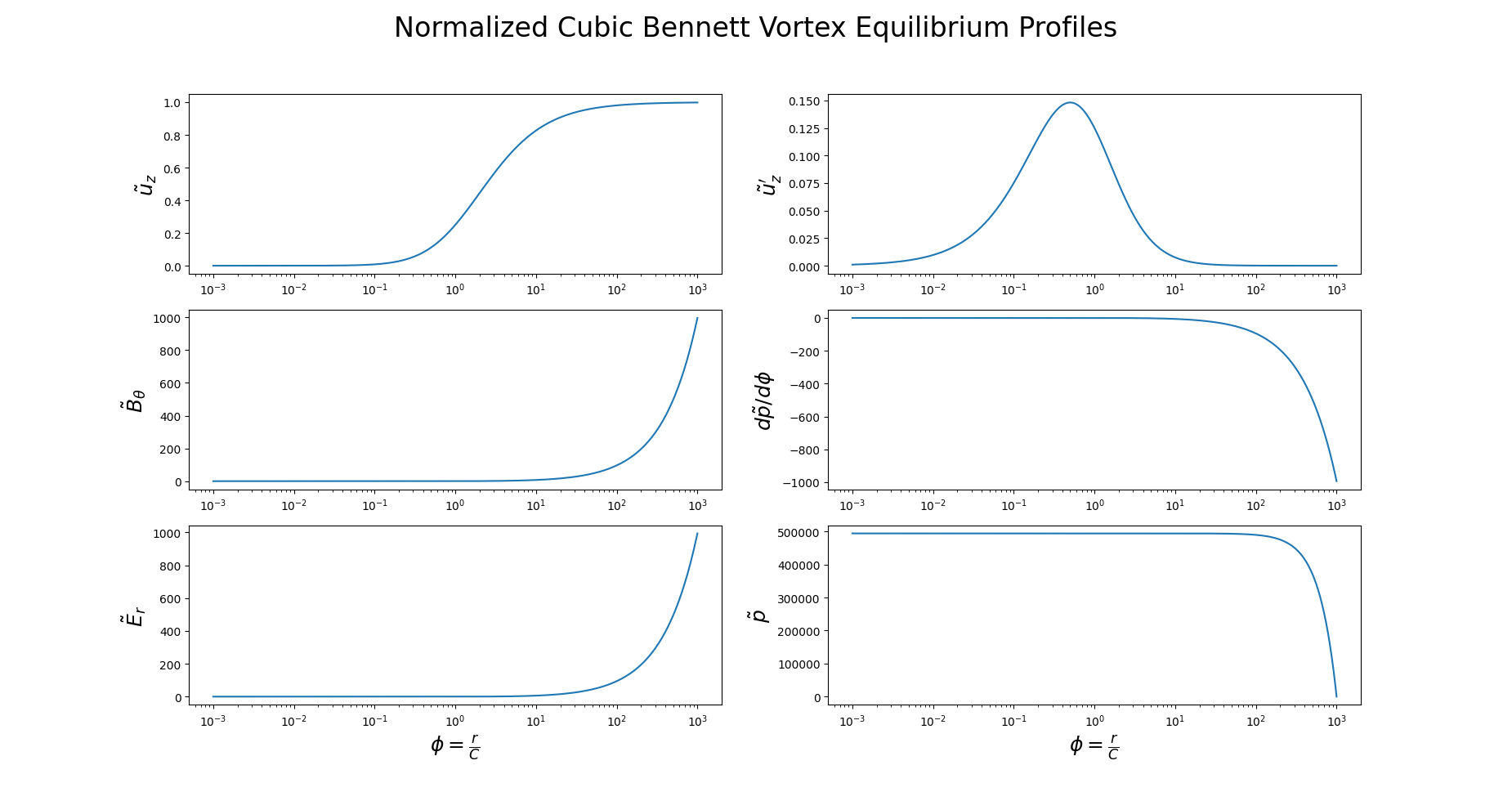
Plots of the equilibrium profiles in a normalized basis using a normalized coordinate that is described in the plot. The normalization used for each profile is a physical one.
https://github.com/russellmatt66/Bennett-Vorticity/blob/main/cubic/basic_properties/cubic_equilibrium.py06 / 07 — QUANTITATIVE COMPARISON
What do the experiments show?
Physics needs to meet with experiment to test its validity
Modelling real world systems with an idealized physics
Solving the equilibrium — on real world data requires extending the model to include a non-zero flow at the core of the device. Without it the model treats the problem as rising from stagnation when in reality experimental systems show shear layers that transition between smaller and larger flows / current densities / intensities.
To solve the equilibrium we have to study the boundary conditions,
The mathematical function we are considering is,
which leads to the following fourth-order algebraic equation when we consider the edge of the plasma / magnetohydrodynamic fluid system,
The roots of this equation are the physical . They exist because the roots of fourth-order algebraic systems have a closed-form, and we can use existing mathematical libraries like Python’s numpy to obtain them. That is what is done in this section, and the results are presented. The code for producing these results can be found in the caption of the respective figures.
To evaluate the accuracies, two different metrics are used. The first is range-normalized relative root mean square error (RNRRMSE),
and ,
The former is used to evaluate all of the applications except the laser-driven shock in a water microjet.
Edge Pedestal
The edge pedestal is a confinement barrier that appears in tokamaks, a toroidal magnetic fusion energy concept, in the presence of an enhanced thermodynamic gradient. This equilibrium is both a confinement barrier, and one that appears in the presence of an enhanced thermodynamic gradient. Therefore, despite its cylindrical nature and idealized structure it is a test of the physics to see if it produces accurate solutions to this experimental system.
MAST
A parameter sweep of the MAST edge pedestal across the span , with total value-pairs swept through is performed and shown in the figures to the right. Every band represents a solution obtained from the analytic model here with less than range-normalized relative root mean square error. The front region is to the right of the connection point, and the wake is to the left. The average core pressure of the wake solutions is calculated to be with a standard deviation, , and median .
DIII-D
The figures show a parameter sweep of the DIII-D edge pedestal across the span , with total value-pairs swept through. Every band represents a solution obtained from the analytic model here with less than range-normalized relative root mean square error. The front region is to the right of the connection point, and the wake is to the left.
The plateau is also swept over so that every point within a tolerance of the maximum intensity is used in this process.
Air Plasma Streamer Head
To model the intensity of an air plasma streamer head, a linear discharge model is assumed to relate the observed intensity with the plasma current density,
This pits the nonlinear structure of the physics against the nonlinear structure of the experimental observations. If they do not match then this usage of a proportionality constant will not make them.
| Region | Root | RNRRMSE (%) |
|---|---|---|
| Wake | 3 | 21.34 |
| Wake | 4 | 10.21 |
| Front | 3 | 14.94 |
| Front | 4 | 19.56 |
| Needletip | 4 | 8.46 |
Table: Air plasma streamer head roots that satisfy the boundary conditions with real roots, along with their accuracy metric.
Laser-driven Shock in a Water Microjet
The same linear discharge model is employed here as was emplyed in the study of the air plasma streamer head.
| ibase | ir | Mean () | Median () | Stdev () | ||
|---|---|---|---|---|---|---|
| 2 | 0 | 0.973 | 0.973 | 0.0001 | 625 | 625 |
Table: Statistics for the most accurate coarse base sweep performed, which is shown in the accompanying figure. Two other pairs of base and edge points, and , had every value above 0.95 as well, but they are not shown.
Zap Shear-flow Stabilized Z-pinch Plasmas
Zap 2001
Single vortex solutions to the axial velocity profile from the 2001 Zap DD fusion plasma experiment are shown. Each pinch is calculated in the uncorrelated pinch basis, and the pinch midpoint is chosen as the connection point between the two. The flow roots for each vortex are complex-valued, for the vortex on the right-hand side, and for the left-hand side. The peak shear of the profiles is the same on both sides . The peak shear obtained from amongst all the roots is . The thermal lifetime is calculated to be for the negative vortex on the left, and for the positive vortex on the right
Zap 2009
| (s) | Root 1 (%) | Root 2 (%) | Root 3 (%) | Root 4 (%) |
|---|---|---|---|---|
| 29.60 | 2.46 | 2.46 | 1.41 | 4.93 |
| 38.40 | 4.68 | 4.68 | 3.28 | 11.10 |
| 41.04 | 7.34 | 7.34 | 4.58 | 15.81 |
| 48.96 | 4.65 | 4.65 | 3.43 | 11.46 |
| 58.64 | 10.37 | 10.37 | 5.92 | 20.61 |
Table: Average RRMSE across all reconstructed segments for each root of the equilibrium at five experimental time points. The most accurate root at each time point is highlighted in bold.
Sources
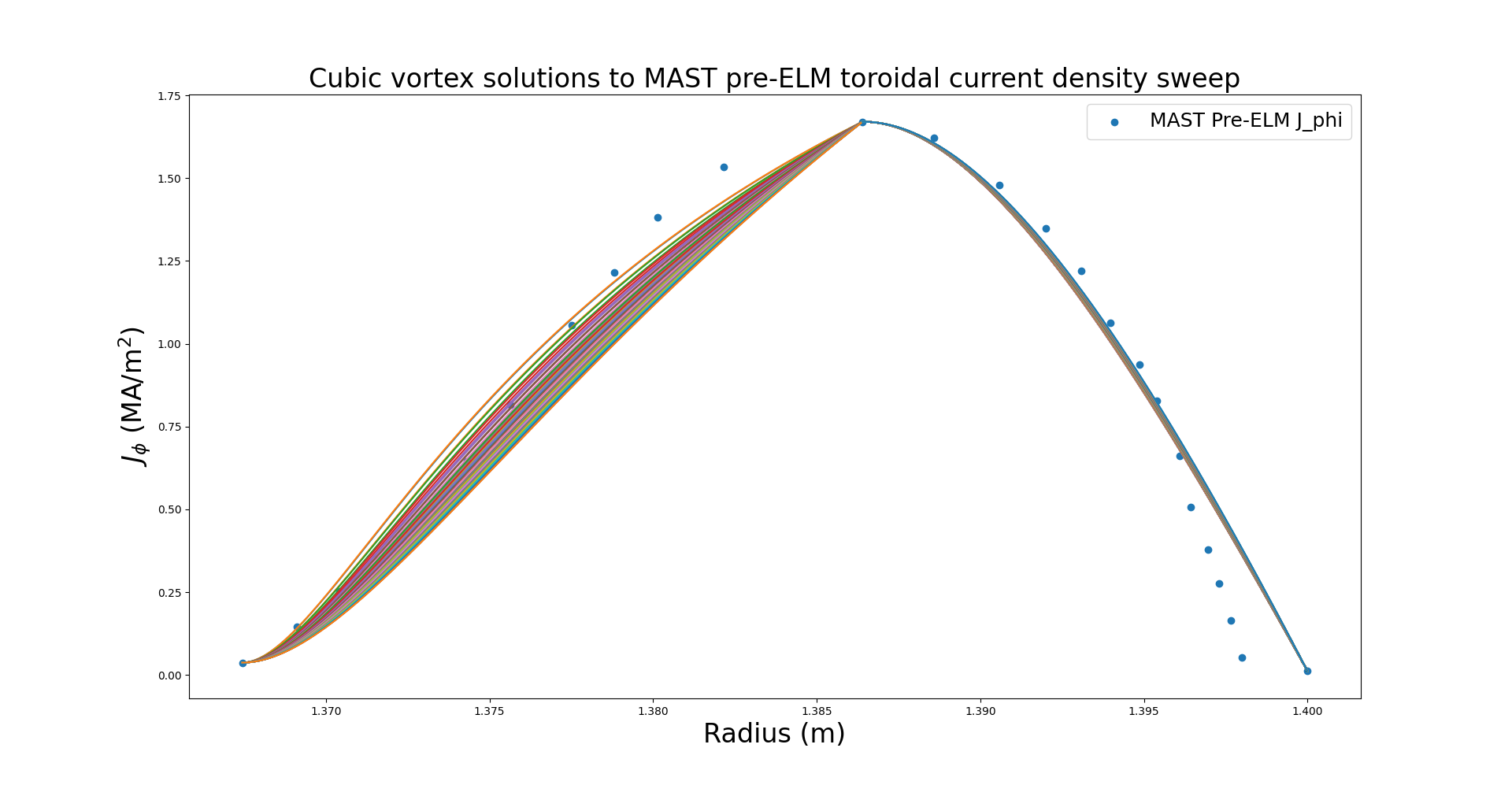
Analytic solutions of the Bennett vortex equilibrium created using experimental data from the MAST edge pedestal. Every curve drawn is a calculated equilibrium with range-normalized relative root mean square error (RNRRMSE) < 10%.
https://github.com/russellmatt66/Bennett-Vorticity/blob/main/cubic/mast_2023/best.py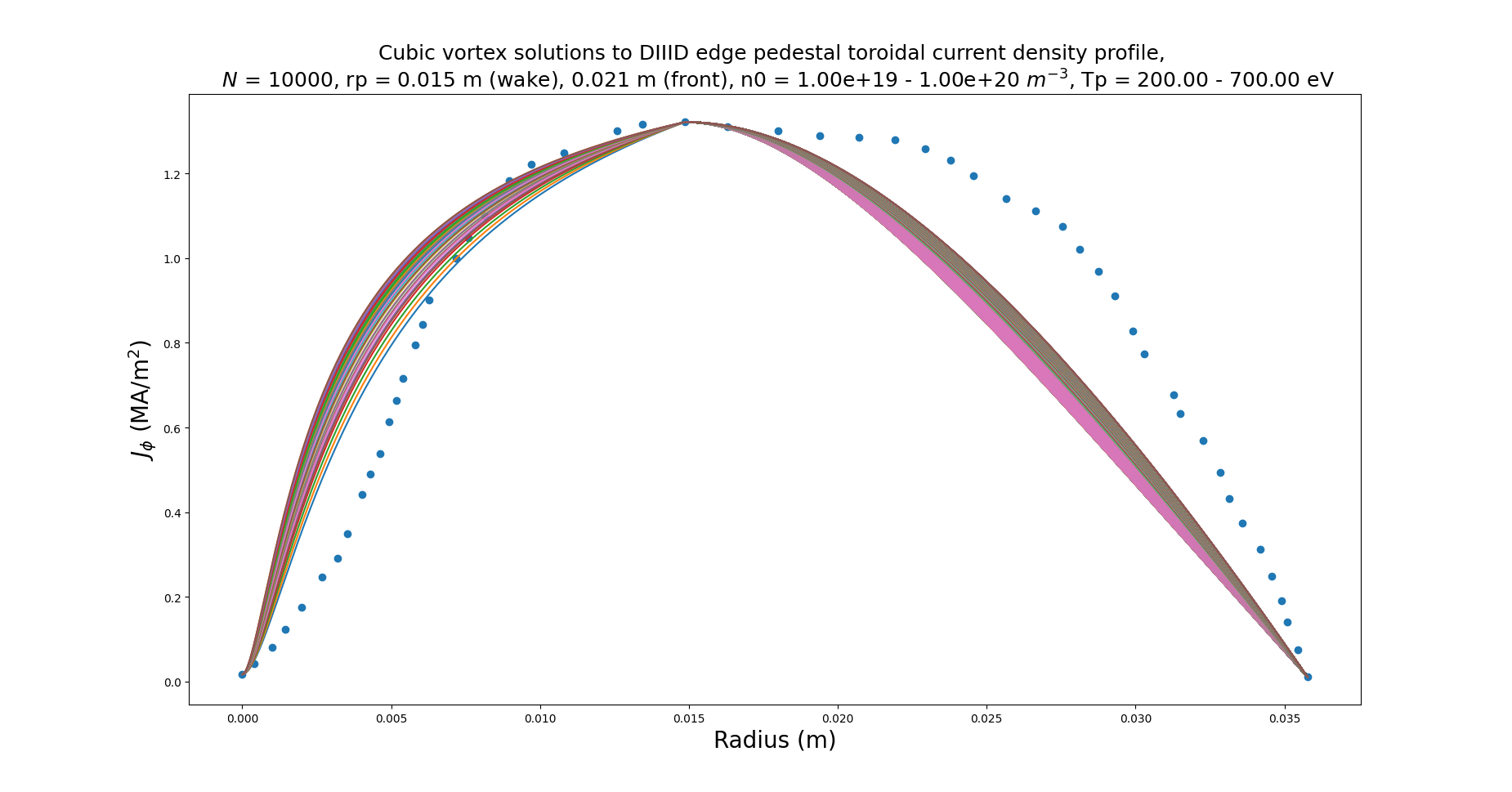
Analytic solutions of the Bennett vortex equilibrium created using experimental data from the DIIID edge pedestal. Every curve drawn is a calculated equilibrium with range-normalized relative root mean square error (RNRRMSE) < 20%.
https://github.com/russellmatt66/Bennett-Vorticity/blob/main/cubic/dIIId/best_DIIID_positive.py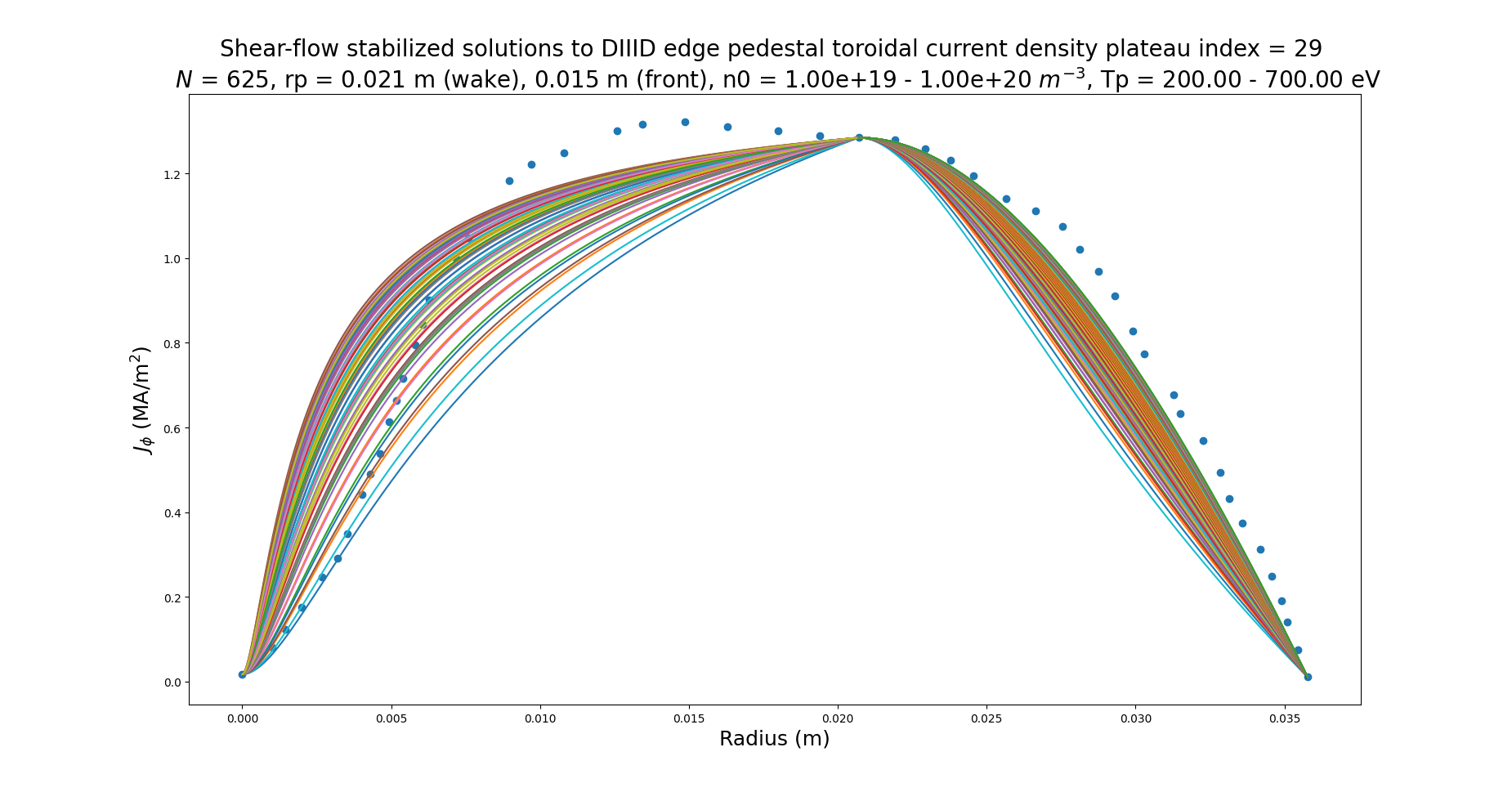
Analytic solutions of the Bennett vortex equilibrium created using experimental data from the DIIID edge pedestal. Every curve drawn is a calculated equilibrium with range-normalized relative root mean square error (RNRRMSE) < 20%.
https://github.com/russellmatt66/Bennett-Vorticity/blob/main/cubic/dIIId/best_DIIID_plateau.py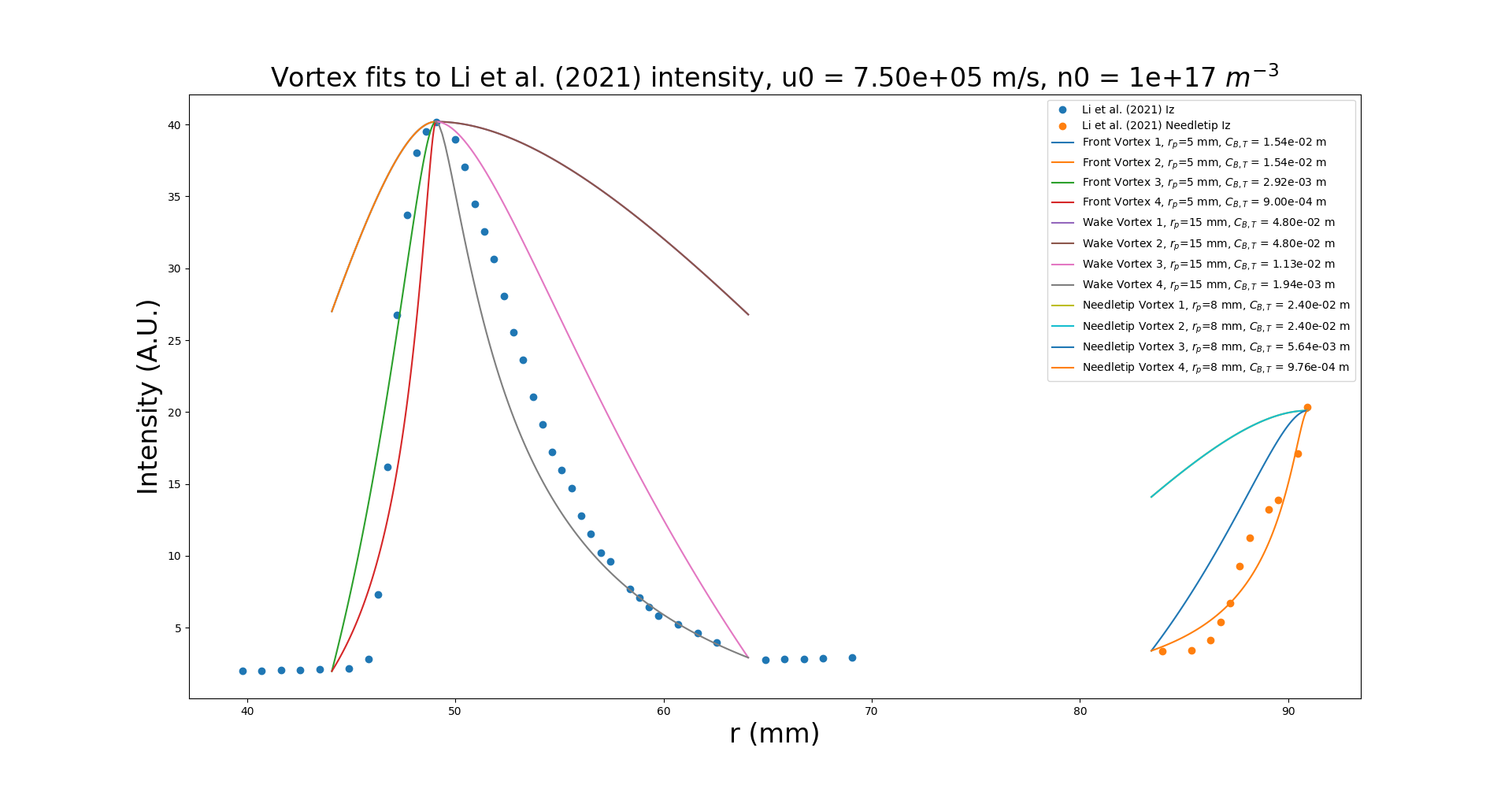
What is most striking about this solution is that the independent variable here is actually the axial coordinate, and not the plasma radius. A solution sweep has not been performed yet using this data. All four solutions defined by the quartic roots are shown. The needletip of the experiment also appears to have a vortex attached to it, perhaps even two.
https://github.com/russellmatt66/Bennett-Vorticity/blob/main/cubic/li_2021/li2021.py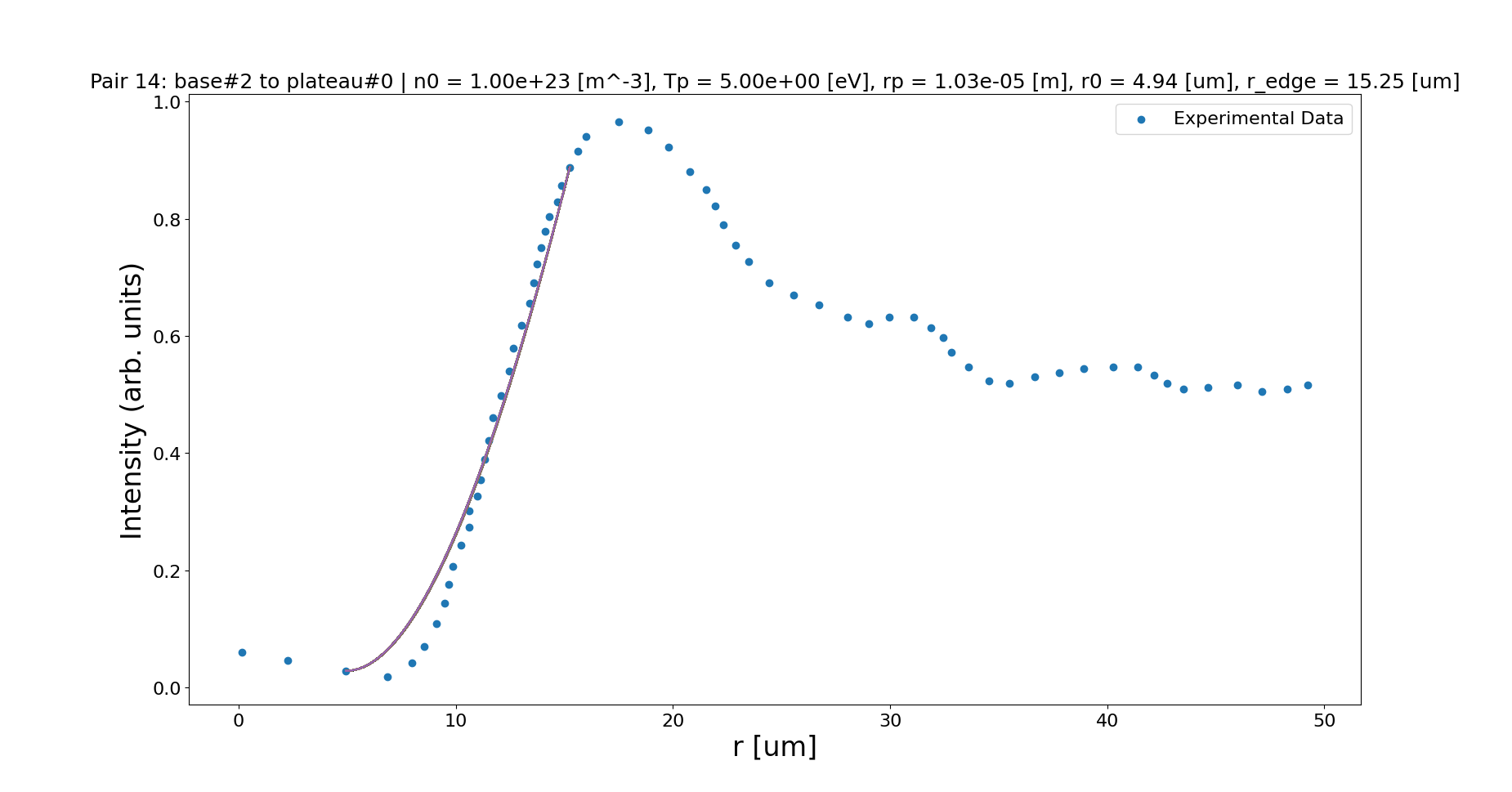
The code that this is produced from sweeps over the base and plateau points, and then sweeps over the edge velocities of the experiment based on the uncertainty in experimental expansion velocity. This is the most accurate sweep created from this procedure with an average R^{2} > 0.973.
https://github.com/russellmatt66/Bennett-Vorticity/blob/main/cubic/microvortex_2025/bellabasesweep.py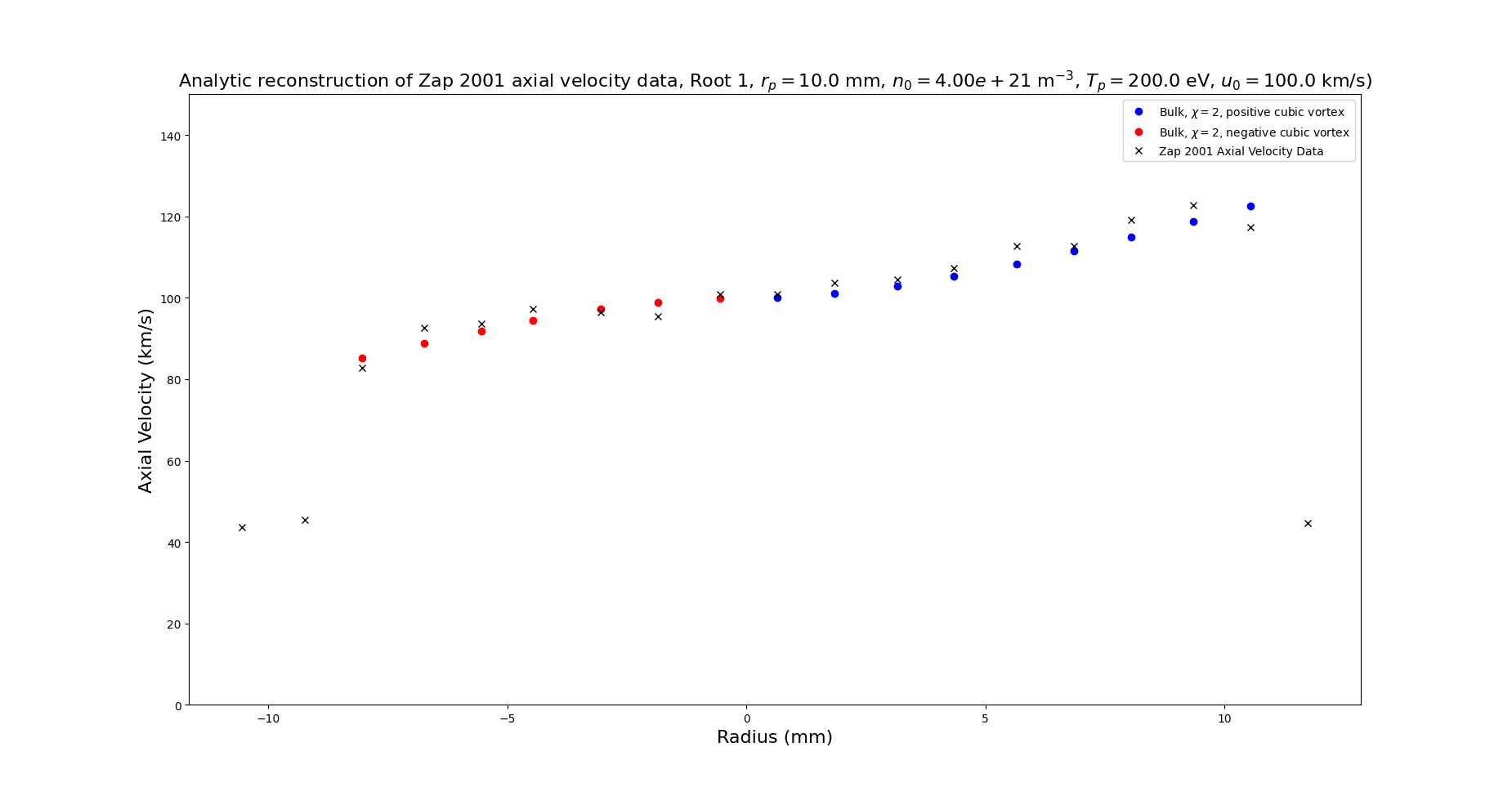
What is particularly interesting about this solution using experimental data from a 2001 shear-flow stabilized Z-pinch experiment is that it is based on a flow velocity root which is complex. Because of this the solution fails to localize the shear correctly so that outside of the interior of the plasma the accuracy of the idealized solution disappears. Yet inside there is evidently a very close match in the subtle structure of the profile.
https://github.com/russellmatt66/Bennett-Vorticity/blob/main/cubic/zap_2001/zap2001.py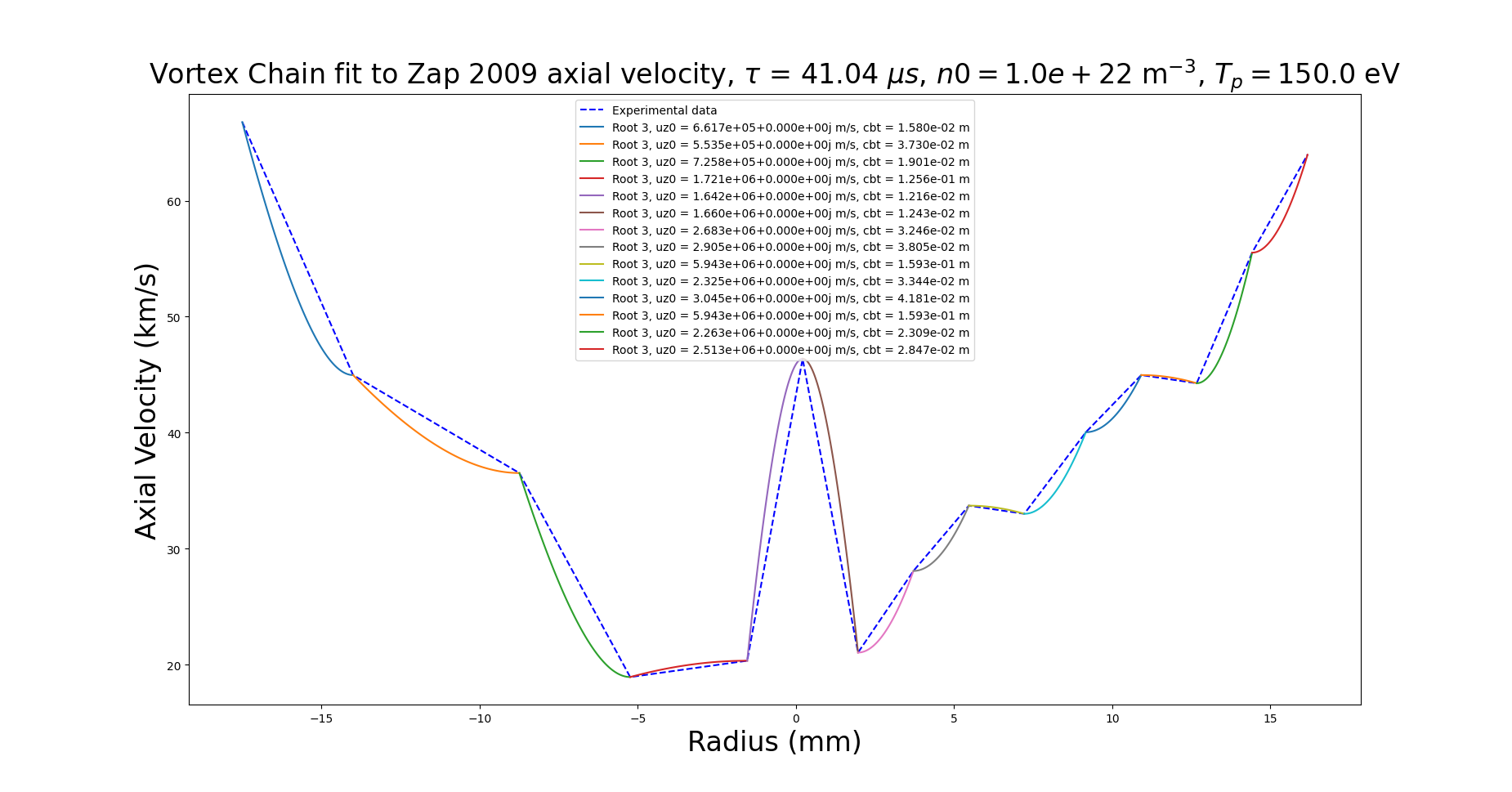
The shear-flow stabilized property of the equilibrium is strongly satisfied in an arbitrarily small pinch radius so the highly turbulent environment of a real experiment, like the 2009 Zap experiments into shear-flow stabilized Z-pinch dynamics, provides a convenient test for whether this can be meaningfully applied to real world data. The solutions here are constructed by treating each cell as a separate physical problem whose roots are solved based on this idealized model.
https://github.com/russellmatt66/Bennett-Vorticity/blob/main/cubic/zap_2009/zap2009_sawtoothchain.py07 / 07 — THE WORK AHEAD
Towards higher-order study
The analytic understanding of an idealized model for a shear-flow stabilized Z-pinch opens new questions related to the higher-order physics and the stabilizing effect of the shear alongside plasma turbulence. These questions involve investigating eigenmode spectra, nonlinear evolution, nonideal transport, experimental tests, and engineering
Next steps for the research
This is just the beginning — What’s most remarkable about this simplified, idealized model is how well it does at accurately modelling complex experimental systems using their experimental data. That is despite only capturing the effects of ideal magnetohydrodynamics, i.e., only what the plasma would do if it was treated purely as a magnetic spring, and involving a uniform density as well as an enhanced temperature gradient that is a very simplified model of an experimental temperature gradient.
What really needs to happen for this research are two things:
(1) Higher-order theoretical and computational work to analyze resistive physics, kinetic physics, and the effect of instabilities just to name a few. This list is by no means an exhaustive one.
(2) Financial stability for myself. Since graduating with a Master’s of Science in Aeronautics & Astronautics from the University of Washington three years ago it’s been really difficult.
My Story
I spent a year hearing rejection after rejection while I worked on a high-performance 3D+t CUDA C Ideal MHD solver until I finally found a job training AI, and got my code to run equilibrium pinch problems without spazzing out. My function was to come up with novel problems that stumped the AI. On three separate days I managed to do this twelve separate times each day by giving the AI Bennett Pinch problems in the infinitely long plasma cylinder.
Eventually, the people paying me said “you’re doing too much Bennett Pinch. Do something different.” So, I sat down and read Davidson’s Turbulence for three hours but to no avail. Asking an AI problems from a book it’s trained on is not going to work, and it didn’t. With only an hour left on the clock, and a need for the money that came from the stump, I did the only thing I could and that was to swap the Bennett profile around so that I could use my code for solving the Bennett pinch to get a value for the system in the limit, , i.e., treating the temperature as uniform.
I’ve had to carry this research to the point where it’s at by myself. That includes a four month hiatus working for a startup as a 3D Motion Engineer where I built a real-time rendered pipeline in Vulkan and authored an 80 page R&D report which detailed the various tradeoffs and approaches to the digital twin they wanted.
The Present Moment
Right now, I’m at the point where I cannot afford to continue to do this much longer.
I’ve spent the last year, and some change, working on this physics while unemployed, and living with my parents. I love my mom and dad, but it gets old and depressing to be a man in my early 30s, waking up in my parents house for months on end to a jobless existence when you have constructed something profound in physics.
Zap Energy approached me about an opening as a senior scientist around the time that I started posting accurate solutions to their 2001 experimental plasmas from this analytic model, but unfortunately these discussions did not progress beyond an initial negotiation over compensation and equity.
I’m not a greedy or unreasonable person, and I could care less about billions. My ambitions are not centered on accumulating extraordinary wealth. I’m oriented more towards family, financial stability, and having my time free to do research over chasing after monetary excess, and the chain of obligations that come with it. I just wanted to see if they respected the result and myself enough to negotiate with me about this.
Support the Research
The next stage of this research requires resources beyond what an independent researcher can reasonably provide alone.
I am actively seeking:
- Institutional affiliation and research funding.
- Collaboration with theoretical, computational, and experimental plasma physicists.
- Access to experimental facilities, and diagnostic measurements.
- High-performance computing resources for numerical stability studies.
- Employment opportunities that would allow this research to continue.
If you are a scientist, research institution, funding organization, or individual interested in advancing this work, I would welcome the opportunity to speak with you. My Linkedin
The objective is to bring this research into an environment where its scientific and technological implications can be fully investigated.

And I need your support